Rethinking Sustainability through the Cosmic Imagination of Miyazawa Kenji (Event Report)


Author: Trent Brown, Flavia Baldari, Tamara Meladze, Julie Dind, Kaori Mita, Terada Yuki, Jesse Rafeiro
Over the last year, the Sustainability and Society Collaborative Project at Tokyo College has been working on an interdisciplinary project, exploring the life, ideas, works, and legacy of the Japanese author, Miyazawa Kenji.
Miyazawa Kenji was born in 1896 and spent most of his short life in and around the town of Hanamaki, in Iwate prefecture. He exhibited a deep concern for the wellbeing of people and other living beings in his locality – which was inspired partly by his involvement in Nichiren Buddhism.
Miyazawa was what we might today call an interdisciplinary intellectual. In whatever ways he could, he tried to mobilise different fields of knowledge to improve the wellbeing of humans and other living beings. He worked as a teacher in an agricultural high school, where he developed innovative ways to inspire students’ curiosity about science and the natural world – including taking students out into nature to learn – something which he writes about in some of his short stories. He was also an agronomist – and very interested in using the latest agricultural science to uplift the condition of farmers.
In his work as an agronomist, Miyazawa consistently sought to bring theory into dialogue with practice, reframing farming as a form of both scientific inquiry and cultural production. He located farmers in an “in-between” zone, recognising their work had both scientific legitimacy and artistic (traditional) value. In doing so, he saw his own role as just one participant in a broader, collective, and creative process, in which farmers played a central role.
Today, Miyazawa is best known for his short stories and poems. Interestingly, however, he published very few of his literary works in his own lifetime. The scholar Hoyt Long (2011) claims that for the most part, Miyazawa’s intention with his stories was to read them aloud to his students – they were meant as pedagogical tools to inspire students’ imagination, to motivate them to learn and to be good human beings. His stories – implicitly or explicitly – teach the importance of being kind to all living beings, to have empathy for those who are different, and they caution against greed, egoism, or mindlessly devouring up material resources. In this way, he showed concern with the advancement of the capitalist economy that was happening in Japan at the time of his writing.
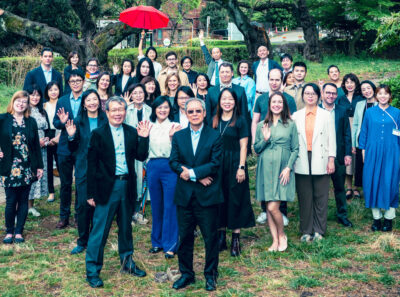
On the 18th of November 2025, we hosted an event at the ITO International Research Centre, both to present the findings of our project and to engage in dialogue with other scholars about themes related to sustainability in Miyazawa’s works.
The event proceeded in three parts. The first set the scene, situating Miyazawa within his cultural and historical milieu. The second looked at the influence of religious ideas – particularly from Nichiren Buddhism – shaped Miyazawa’s works and ideas, particularly his ethics of engagement with the more-than-human world. The third part of the event examined Miyazawa’s enduring legacy in Iwate prefecture.
The event began with a keynote speech by Haruo Shirane, who is Shincho Professor of Japanese Literature and Culture at Columbia University in the United States. Shirane-sensei is a long-term friend of Tokyo College, whose work explores more-than-human themes in pre-modern Japanese literature. His talk situated the work of Miyazawa Kenji and similar authors within what he describes as the ‘Eco-social imaginary of Japan,’ a concept he is developing in a forthcoming book. As Shirane-senseii explains, this ‘ecosocial imaginary’ refers to:
a singular way of living and making its own existence, which binds the community together with its physical environment. The “social” is not just the human community but the larger community of non-humans: animals, reptiles, birds, tall trees, and mountains (earth-beings).
Shirane-sensei went on to explain how, from this perspective, ritual, folklore, and storytelling practices are highly interwoven with the ecology of Japan.
We then heard from Ms. Michiko Miyagawa and Prof. Masahiro Miyagawa from Yui Park Forest, an initiative in Iwate prefecture to preserve the satoyama system and encourage educational farmstays. The couple gave a lively recital of Kenju Park Grove (虔十公園林), one of Miyazawa’s most touching stories, believed to have been written in the years before his death in 1933. It tells the story of Kenju, a boy who, it is implied, has an intellectual disability. One day, as if by divine inspiration, Kenju plants a grove of cedar trees on some unproductive agricultural land. He does so without any commercial intention or sensibility and so others in the village mock him. As time passes, however, they are amazed that the grove Kenju plants becomes a place where young children gather to play: and they continue to do so for generations to come, even after Kenju passes away. The story speaks to Miyazawa’s deep empathy for people excluded from society, his appreciation for those who take inspiration from nature, the natural affinity between children and wild places, and the fact that we don’t always know who in this world will have a lasting legacy and who will not.
The next two speakers were experts on Miyazawa Kenji’s works and ideas, both of whom spoke of the religious influences on Miyazawa’s perspective on the more-than-human world. P. A. George, Emeritus Professor at Kanagawa University, talked about the notions of co-dependence in Miyazawa’s thought and how stories like Kenju Park Grove and The Restaurant of Many Orders speak to humans’ interdependencies on the natural world. Ultimately, they communicate Buddhist conceptions of how human happiness is contingent upon the happiness of other sentient beings. Next, Dr Aino Fukada, a JSPS Postdoctoral Research Fellow (PD) at the Institute for Buddhist Culture, Musashino University, spoke to the ways in which Miyazawa’s writings draw on the Buddhist notion of geshu. Geshu refers to sowing the seeds of Buddhahood in everyday life and rests on the assumption that – particularly in this epoch – humans are not receptive to direct attempts to ‘preach’ the value of good behaviour. Rather, demonstrating the value of goodness through one’s own actions can sow seeds of Buddhahood into the hearts of others. It is Dr Fukada’s contention that this is what Miyazawa sought to do through his short stories. Her perspective speaks to the value of literature in touching people and transforming values where direct discourse often fails.
The final talk was a panel with Prof Masahiro Miyagawa and Dr Jesse Rafeiro. Prof Miyagawa shared his story of starting the Yui Park Collective, along with his family and other members of his community. This collective aims to preserve traditional Japanese agroforestry practices (which are key components of the satoyama socio-ecological system) and to share the benefits of living close to nature with students through educational farmstay experiences. Miyagawa-san was partly inspired to take up this initiative by Miyagawa’s story Kenju Park Grove – particularly, by the way in which the story suggests natural spaces encourage children to play, without any instigation. The Yui Park Collective aims to teach young people the value of being in nature and experiencing the world through their five senses, rather than through studying in classroom settings.
Dr Rafeiro then talked about the project undertaken by the Sustainability and Society Collaborative at Tokyo College. He shared how, like Miyagawa-san, many residents of Iwate prefecture have been inspired by different aspects of Miyazawa Kenji’s ideas and attempted to incorporate them into their practice. These include the local government, which has attempted to not only draw on Miyazawa’s image for the promotion of tourism in the region, but also to instil his ethos within the society. There have also been efforts to designate significant landscape features that appear in Miyazawa’s life and works as heritage sites. Examples such as the English Coast show these sites enact alternative ways of understanding local geography both in informal ways and in community events. Considerable effort has also gone into creating museums that reflect Miyazawa’s unique worldview and creative practice.
With our project, we did not simply aim to study Miyazawa Kenji—his writings and his worldview. In our own way, we also tried to live and experience his proposal, bringing practice together with knowledge. The workshop was an excellent opportunity to share our work with specialists of Miyazawa, but also—thanks to the presence of representatives from the Yui Park Forest—an occasion to give back to the Hanamaki community some of what we had learned from them.
Works Cited
Long, H. (2011). On Uneven Ground: Miyazawa Kenji and the Making of Place in Modern Japan. Stanford, CA: Stanford University Press.