Tokyo College aims to generate new knowledge to contribute to the creation of an inclusive society and spark deeper public engagement with the University. You can see the various events in calendar format on this page.
This presentation will describe environmental interventions to prevent obesity and non-communicable diseases in urban food environments. Dr. Gittelsohn will highlight strategies, impacts and lessons learned from the Baltimore Healthy Food initiatives, as well as the work of other researchers. Evidence shows that combining educational, environmental, and policy approaches improves access to and consumption of healthier foods, though impacts on obesity remain modest. His current work explores digital tools, restaurant and systems science approaches. Findings underscore the need for sustainable, community-engaged strategies to strengthen food environments and reduce chronic disease risk.
Wildfires are becoming more frequent and intense, even in historically less affected regions. This talk examines the drivers, consequences, and management of changing wildfire dynamics. A more flammable landscape—shaped by climate change, land abandonment, and afforestation—is intensifying fire regimes globally. While most of the 780 million hectares that burn annually are low-intensity savanna fires, high-intensity, destructive wildfires are increasing. Fire is an ancient ecological process with both benefits and harms, shaping ecosystems yet threatening lives and property. As suppression alone is insufficient, I advocate proactive adaptation through prevention, restoration, land-use planning, coordination, and improved fire literacy.
In this richly-illustrated lecture, I discuss two collaborative partnerships in which I have been involved with historically marginalized, Indigenous communities in both the Himalayan region and in Native North America who are working to preserve and revitalize their languages. Through the presentation, I explore these three words: Collect, Protect, Connect.
Japan had two elections—LDP President (September 27) and House of Representatives (October 27)—that elected a new prime minister. During the two elections, many economic policy proposals were presented and debated. The webinar will discuss economic policies that are likely to be adopted and those that are unlikely to be adopted but desirable for the Japanese economy.
As generative AI becomes more widely used, it is crucial for AI models to accurately reflect cultural and linguistic risks in different regions. Identifying harmful content specific to each culture must be continuously updated. This requires collaboration between AI researchers, social scientists, policymakers, and practitioners to form a global community for ongoing discussions. This event will discuss frameworks to sustain such communities, welcoming those interested in AI safety and governance.
Event Calendar
Tokyo College held a public lecture on “Kidney Diseases: Taming the Silent Killer.”
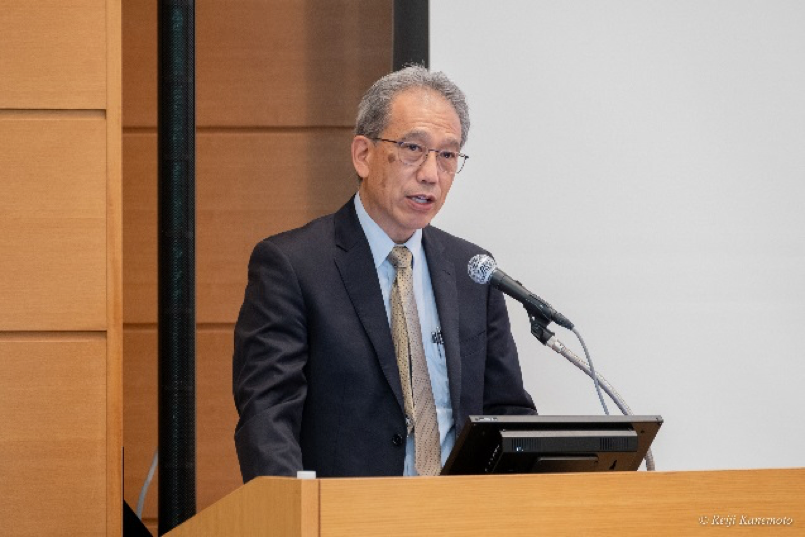
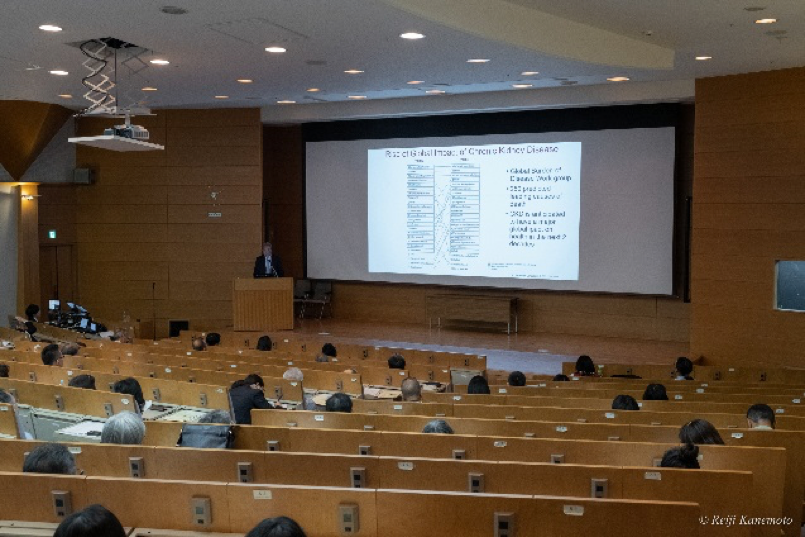
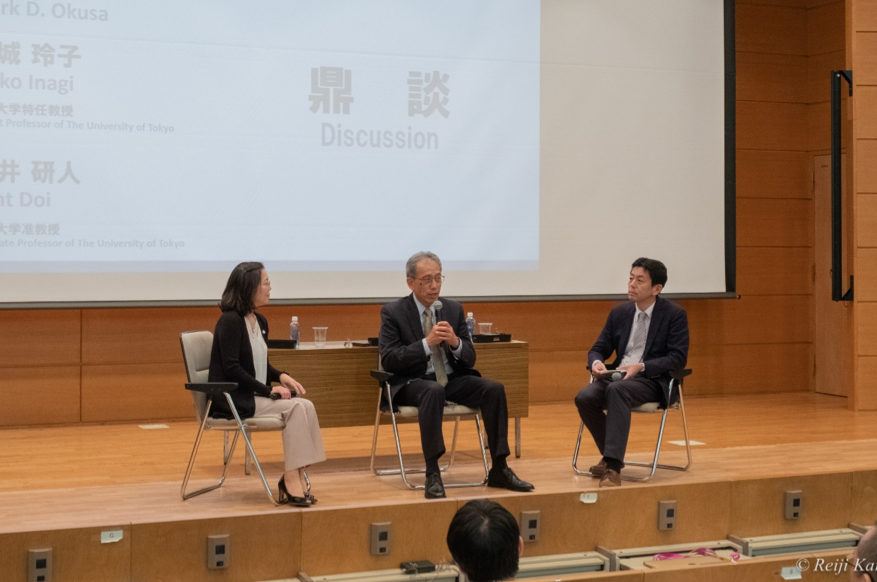
On September 19, 2019, Professor Mark D. Okusa (University of Virginia) gave a lecture on “Kidney Diseases: Taming the Silent Killer.” Professor Okusa, Chief of Nephrology at the University of Virginia and a leader in research relating to Acute Kidney Injury (AKI) and immunology introduced the burden of kidney disease (a global issue), kidney failure, health policy, and landmark studies in nephrology, and discussed forward-thinking kidney research and innovation. In the latter half of the session, Professor Okusa participated in a three-way discussion with Project Professor Reiko Inagi (University of Tokyo) and Associate Professor Kent Doi (University of Tokyo).
The function of the kidneys, and increasing kidney disease
After an explanation of the purpose of the lecture from Professor Satoru Ohtake (College Deputy Director), Professor Okusa stated that the kidneys are among the most important organs in the body, creating hormones and maintaining bone health, and influencing blood cells, excretion, and blood pressure, but kidney disease is a subtle and silent disease. At present there are 850 million people around the world suffering from kidney disease (twice the number of diabetics and 20 times the number of HIV patients), and even in Japan there are 13 million patients with Chronic Kidney Disease (CKD), and 300,000 people who have undergone dialysis or transplant. Although there are regional and gender differences, End-Stage Renal Disease (ESRD) has become a global problem.
Kidney disease as a global problem
Professor Okusa then positioned the cost of treating kidney disease as a global problem. Because kidney disease is expensive to treat, and because there is a limited number of the machines required for dialysis, there is the problem that access to treatment is not evenly distributed. Professor Okusa used the example of public health policy in the United States to explain this. In 1972 President Richard Nixon signed a law to extend the coverage of government-funded Medicare to include patients with kidney failure in America, resulting in the provision of subsidies for patients over 65 years old and to dialysis patients. In recent years, although it has become possible to use a new immunosuppressant drug azathioprine, and the potential for transplant has widened, the financial burden has continued to be a problem. Professor Okusa noted that governments will continue to bear the costs for treatment of kidney failure going forward, and that it is necessary to implement sustainable policies.
Innovation and the future
Professor Okusa introduced the genetic insights from a study of African-Americans, and research published in the New England Journal of Medicine in 2019 in which an association was indicated between canagliflozin and clinical outcomes for type 2 diabetes and kidney disease, as recent landmark studies. He said that in the future 3D and AI technologies may make it possible to predict kidney disease. However, Professor Okusa pointed out that it is necessary to overcome the significant gap referred to as the “valley of death” in order to apply new discoveries and innovations to actual treatment, and stated that public-private partnership is important in order to compensate for insufficient product development funding.
Three-way discussion
After the lecture, Professor Okusa participated in a three-way discussion with Project Professor Inagi, who specializes in molecular biology and nephrology, and Associate Professor Doi, who specializes in emergency medicine, considering the treatment of kidney disease and its future from the perspectives of research and treatment. The participants exchanged views on the future of artificial organs and the prevention of kidney disease, and there was a question from the floor on what is needed in the future to create an organ atlas. Professor Okusa responded that once we understand a single cell in the kidneys, we should understand which drugs can treat a particular disease. He also spoke some words of encouragement for the young doctors gathered at the venue, saying that nephrologists need to understand not only the kidneys, but also the heart, lungs, and digestive organs, and that nephrologists might be the best physicians.
Previous Events
You can search by keywords such as speakers and lecture themes.