Event Report
GPAI Future of Work: Survey Report 2023 in Japan
Date & Time: Wednesday, March 6, 2024, 10:00 am - 12:00 pm
Venue: Zoom Webinar
Organized by: Tokyo College, The University of Tokyo
GPAI Future of Work Working Group and Survey in Japan
The Global Partnership on AI (GPAI) is an international initiative dedicated to the development and use of "responsible AI" based on a human-centric approach.[1] GPAI has several working groups, one of which is the Future of Work (FoW) Working Group. As part of this working group’s project work, case studies have been collected through student-led interview surveys in participating countries, with the aim of reflecting workplace situations in international discussions on how our ways of working will change as AI is introduced into the workplace. The Japan team, consisting of participants from several universities, has been conducting surveys for the project work since FY2021, and FY2023 was the third year for the team.[2]
At this event, students and professors who participated in the 2023 Japan team took the stage to present an overview of the survey and some of the findings obtained, as well as to discuss the significance and challenges of the survey. The program was as follows:
- Opening Remarks
- Introduction of the GPAI Future of Work
- Overview of the Future of Work Survey 2023 in Japan
- Student Panel Discussion
- Professor Panel Discussion
- Closing Remarks
The details of the program are explained in the following sections.
- Opening Remarks
The event began with opening remarks by Dr. Arisa Ema (Associate Professor, The University of Tokyo).
Dr. Ema, an expert member of the GPAI Future of Work, explained the purpose of the event, which was to discuss topics related to the Future of Work survey conducted in Japan in FY2023. She also touched on the significance of the GPAI as an international network and Japan's continued contribution to it. In addition, referring to the upcoming establishment of the GPAI Tokyo Center this spring, she expressed her hope that GPAI-related activities in Japan will become more widely active in the future.
- Introduction of the GPAI Future of Work
Following the opening remarks, Dr. Yuko Harayama (Professor Emeritus, Tohoku University) introduced the GPAI and the Future of Work Working Group.
Dr. Harayama, an expert member and 2020-2021 co-chair of the GPAI Future of Work, explained that the GPAI was formally established in June 2020 under the leadership of Canada and France, following discussions within the G7 framework triggered by the 2019 OECD Principles on AI. She also explained that to date, 28 countries and the EU have joined the GPAI as international partners, and that multi-stakeholder discussions involving industry, government, academia, and civil society are taking place to bridge theory and practice in the development and use of human-centric "responsible AI."
According to Dr. Harayama, the Future of Work Working Group, one of GPAI’s four working groups, is composed of 26 experts and is working to build collective knowledge about topics such as the impact of AI on work and how to respond to it, using methods including the examination of case studies from various countries. Dr. Harayama presented several projects currently underway in the Future of Work,noting the trend of focusing on generative AI and non-G7 countries. Furthermore, she explained that as part of the working group’s project work, case studies have been collected in participating countries through student-led interview surveys with the aim of reflecting workplace situations in international discussions, and that the survey in Japan presented at this event will also be reflected in the reports by the Future of Work in 2024.
- Overview of the Future of Work Survey 2023 in Japan
Prior to the panel discussions, Dr. Ema gave an overview of the Future of Work interview survey conducted in Japan in FY2023.
According to Dr. Ema, the 2023 Japan team that conducted the survey was composed mainly of participants from three universities, Doshisha University, Toyo University, and The University of Tokyo, and was managed by Dr. Harayama, Dr. Ema, and Prof. Kosei Miyazaki (Hyogo University). As in the previous two years, students took the lead in conducting the interviews for the survey, and when consent was obtained, they also incorporated the interview results into their own research. Through the interviews, 27 case studies of companies, organizations, and local governments in 12 industries (IT, auditing, consulting, information and communications, finance and insurance, beverage, manufacturing, logistics, real estate, entertainment, education, and local government) were collected according to the students’ interests and majors. For each interview, the students developed a set of questions based on the GPAI’s standard questionnaire and tailored to the interviewee. Each set covered topics related to the AI system itself and the interaction between humans and the system while incorporating ethical considerations.
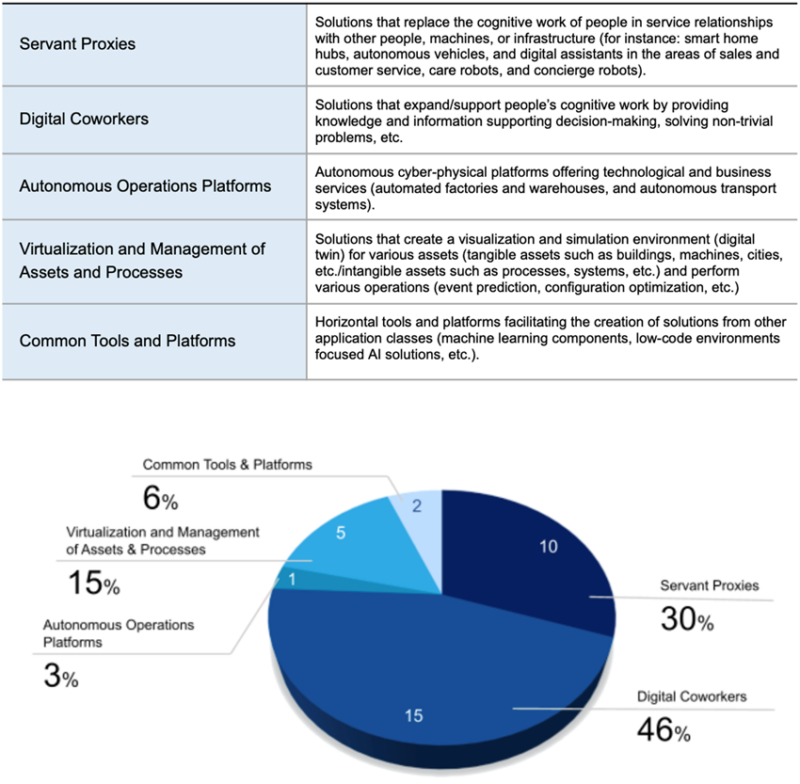
As a brief analysis of the 2023 survey results, Dr. Ema, referring to the categories of AI systems set by the GPAI, explained that many of the collected cases involved AI systems categorized as "digital co-workers," which expand or support people’s cognitive work by providing knowledge and information, or "servant proxies," which replace people’s cognitive work, while few involved "autonomous operations platforms."
To conclude her presentation, Dr. Ema expressed her gratitude to the interviewees and all others involved, adding that she hopes to maintain and further strengthen the network established through the survey.
- Student Panel Discussion
Panelists: Shinnosuke Ushioda (Undergraduate Student, Doshisha University)
Yuika Mori (Undergraduate Student, Doshisha University)
Yu Nagasawa (Undergraduate Student, Toyo University)
Jun Kuribayashi (Master's Student, The University of Tokyo)
Moderator: Arisa Ema (Associate Professor, The University of Tokyo)
In the student panel discussion moderated by Dr. Ema, four students representing the four seminars involved in conducting the 2023 survey took the stage to discuss their findings gained through the survey.
Mr. Shinnosuke Ushioda, who surveyed the logistics industry, referred to an AI system that predicts cargo volumes with an error of a few percent, and expressed his understanding that even with the use of AI systems to allocate personnel and trucks, securing manpower remains an issue in labor-intensive industries.
Ms. Yuika Mori, who surveyed the information and communications industry, introduced automated mosaicing software that has contributed to increased work efficiency, reduced costs, and improved work styles. With regard to this software, she shared her findings that its widespread use in the broadcasting industry, which she had initially assumed, would be fraught with difficulties as it could take jobs away from some companies in the industry, where the inter-company division of labor has progressed, and that there is a need for such software to protect personal information in the transportation, retail, medical, and other industries.
Mr. Yu Nagasawa, who surveyed the auditing industry, stated that the adoption of AI in small and medium-sized auditing firms has made little progress, citing cost issues and insufficient digital skills among accountants as reasons for this. He suggested that in addition to self-help efforts at the individual and firm levels, support at the national and industry levels could be considered as an approach to these issues.
Dr. Ema asked the three students how they would work with AI if they were to work in the industry they had surveyed in the near future. In response to this question, Mr. Ushioda, who surveyed the logistics industry, expressed his view that humans will use AI as an aid, while noting the potential for further proliferation of AI in the industry. Ms. Mori, who surveyed the information and communications industry, opined that AI technologies related to personal information protection have significant potential for further development, and that there are likely to be situations in which such technologies will be required to reflect human values and ethics. Mr. Nagasawa, who surveyed the auditing industry, mentioned the potential for further use of AI-OCR and expressed his view that humans will focus on more intellectual tasks, leaving routine and monotonous tasks to AI.
Mr. Jun Kuribayashi, who surveyed the entertainment industry and assisted in the management of the 2023 survey in Japan, referred to a case he had surveyed in which the work of freelancers was affected by AI, and raised the importance of interview surveys targeting not only those in charge of development and implementation of AI systems (services) at companies, organizations, and local governments. In response to this suggestion, Dr. Ema, while noting the difficulties involved, stated that given the recent proliferation of generative AI, it is becoming increasingly important to include the voices of individuals who are difficult to reach.
- Professor Panel Discussion
Panelists: Masayo Fujimoto (Professor, Doshisha University)
Hirofumi Katsuno (Associate Professor, Doshisha University)
Max(Masafumi) Nakano (Professor, Toyo University)
Kosei Miyazaki (Professor, Hyogo University)
Moderator: Yuko Harayama (Professor Emeritus, Tohoku University)
In the professor panel discussion moderated by Dr. Harayama, four professors who were involved in the 2023 survey took the stage to discuss the significance and challenges of the survey, as well as the findings derived from guiding the survey.
First, the professors reviewed how their students collected case studies for the survey. Prof. Masayo Fujimoto explained that her students surveyed a wide range of industries from an industrial sociological perspective. Prof. Hirofumi Katsuno noted that his students focused on the information and communications industry and the entertainment industry with an interest in media studies. Both professors stated that it had become more difficult to find companies, organizations, and local governments willing to be interviewed compared to the previous two years. Prof. Max(Masafumi) Nakano explained that his students surveyed the auditing industry and the IT industry according to their interests and majors, and that especially in the auditing industry, the focus in FY2023 was on small and medium-sized auditing firms, as opposed to the large firms they focused on in the previous year. Prof. Kosei Miyazaki, who supported the entire survey and acted as a liaison to companies, organizations, and local governments, expressed his recognition that many of them had become more deeply and seriously involved with AI than in the previous year, making the survey more difficult for both students and potential interviewees.
Next, the professors discussed their findings about the workplace, focusing on changes from the previous year. Prof. Fujimoto stated that in the 2023 survey, she encountered not only workplaces where AI was handled in a pioneering manner, which she had mainly seen in the past, but also workplaces where AI systems and services had been introduced without strong necessity, and users were fumbling with them without sufficient knowledge. Citing the case of a conversational AI service, Prof. Katsuno noted that a culture of agile service development and deployment, where users share a common understanding of the characteristics of AI services, has been cultivated in some parts of Japan. Prof. Nakano explained that the idea has emerged in the workplace that humans should use AI to do work that only humans can do, such as developing new businesses. He also highlighted challenges in the auditing industry, such as uncertainty about how to deal with AI outputs and polarization in the progress of AI use. Asked specifically about generative AI, Prof. Miyazaki expressed his recognition that generative AI has forced companies to rethink their approach to AI, and that it will take some time to see major changes in the workplace in terms of implementation.
The professors also discussed the significance and challenges of the survey. Regarding the significance of the survey, they noted not only the knowledge gained, but also the value of the opportunity for students to participate in a global project and explore social change in real time, and the fact that through their interactions with working people outside of universities, the students are being trained to become members of society with their own strengths. Regarding the challenges of the survey, it was discussed that in order to gain more meaningful knowledge, it is necessary not only to accumulate the number of interviews, but also to make further efforts, such as delving deeper into case studies and making international comparisons. The need to maintain and strengthen the network established through the survey was also mentioned.
At the end of the session, there was also a discussion based on a question posed by a webinar participant. Through the discussion, the professors agreed that the way people interact with AI in the workplace depends not only on the industry, but also on various factors such as the size, culture, and location of the company, organization, or local government, as well as the generation and educational background of the workers. They also touched on issues related to reskilling in membership-based employment systems. Dr. Harayama concluded the session by noting the need for further exploration in future surveys.
- Closing Remarks
At the conclusion of the event, Mr. Yoichi Iida (Ministry of Internal Affairs and Communications) gave the closing remarks.
Mr. Iida stated that Japan has been leading international discussions on AI in the G7, OECD, and other forums since around 2016, and emphasized the importance of the GPAI’s efforts and the significance of the upcoming establishment of the GPAI Tokyo Center. He concluded his remarks by expressing his gratitude for the fact that amid the need for discussions by diverse stakeholders, the Future of Work survey in Japan has been conducted with the cooperation of many interviewees while educating students, and that the event introducing such a survey was held with many participants.
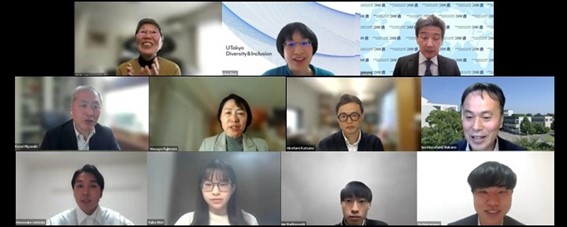
Top row from left to right: Dr. Harayama, Dr. Ema, and Mr. Iida
Middle row from left to right: Prof. Miyazaki, Prof. Fujimoto, Prof. Katsuno, and Prof. Nakano
Bottom row from left to right: Mr. Ushioda, Ms. Mori, Mr. Kuribayashi, and Mr. Nagasawa
(Based on a report by Jun Kuribayashi)
[1] GPAI Website, https://gpai.ai/
[2] "GPAI Future of Work Survey Report 2022 in Japan," https://ifi.u-tokyo.ac.jp/en/project-news/12135/